


Microservices vs. Monoliths: Which Architecture Should You Choose in 2026?
Introduction: The Architecture Decision That Shapes Everything
Every enterprise software system starts with a foundational architecture decision. Whether you are building a new platform from the ground up or modernising a legacy application that has grown unwieldy over the years, the choice between a microservices architecture and a monolithic architecture will influence your development velocity, system reliability, team structure, operational costs, and ability to scale — for years, if not decades.
Yet this decision is rarely made with the rigour it deserves. Many organisations default to one approach based on trend rather than context. In 2010, monoliths were the norm. By 2018, microservices had become the aspirational standard, championed by Netflix, Amazon, and Uber. By 2026, the industry has matured enough to know that neither architecture is universally superior — and that the wrong choice, regardless of which it is, can become an expensive technical liability.
This article provides a comprehensive, unbiased analysis of both architectures — what they are, where they excel, where they break down, and how enterprise technology leaders should think about the decision in today’s environment of AI integration, cloud-native infrastructure, and increasingly complex business requirements.
Understanding the Fundamentals
What Is a Monolithic Architecture?
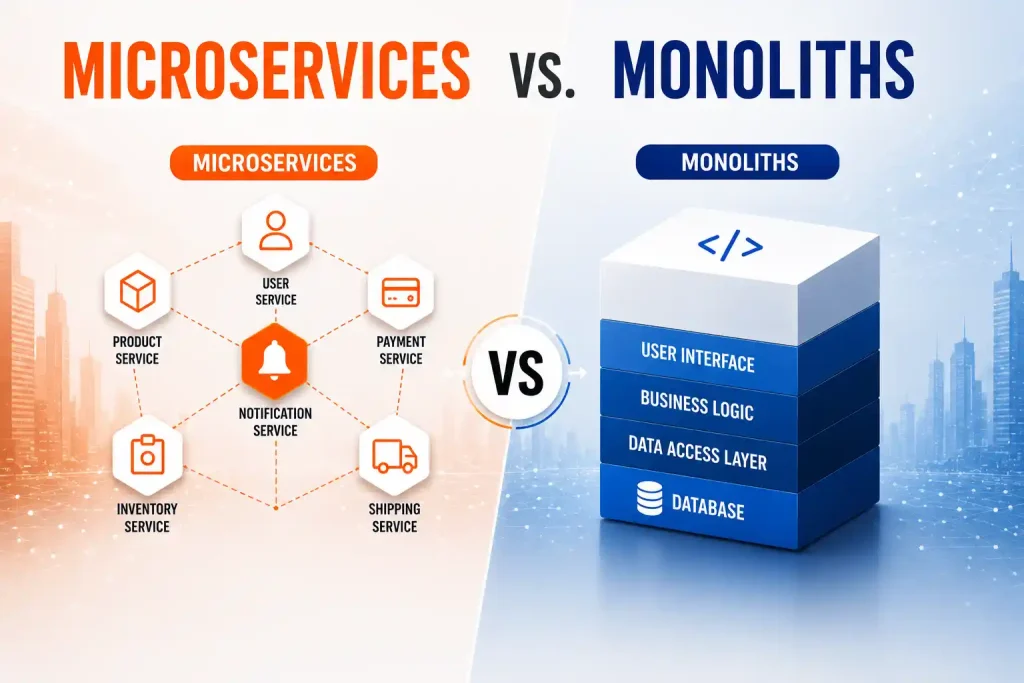
A monolithic application is one in which all components of the system — the user interface, business logic, and data access layer — are tightly coupled and deployed as a single, unified unit. When you make a change to any part of the application, you must redeploy the entire system.
Monolithic architectures were the dominant paradigm for decades, and for good reason. They are straightforward to develop in the early stages, simple to test end-to-end, and easy to deploy when the application is small. A development team working on a monolith shares a single codebase, which reduces coordination overhead and makes it easy to trace how components interact.
Architecture Note: A well-structured monolith built on clean architecture principles is not a liability — it is a stable, predictable, and often cost-effective foundation for businesses that have not yet reached the scale where its limitations become constraints.
What Is a Microservices Architecture?
A microservices architecture decomposes an application into a collection of small, independently deployable services, each responsible for a specific business capability. These services communicate with each other through well-defined APIs — typically RESTful HTTP calls or asynchronous message queues — and can be developed, deployed, and scaled independently.
The microservices model emerged as a response to the limitations that large organisations encountered when scaling monolithic systems. Netflix, for instance, famously transitioned to microservices after a database corruption incident in 2008 brought their entire platform down for three days. The need for resilience, independent deployability, and the ability to scale individual components differently drove the shift.
In a microservices architecture, a single e-commerce platform might be composed of separate services for user authentication, product catalogue, inventory management, payment processing, order fulfilment, and notification delivery — each running in its own container, maintained by its own team, and deployable without touching the others.
A Detailed Comparison: Strengths and Limitations
Development Speed and Team Productivity
In the early stages of a project, monoliths offer a clear productivity advantage. There is no inter-service communication overhead to manage, no need to define API contracts between teams, and no infrastructure complexity to navigate. A small team can move quickly with a single shared codebase, a single build pipeline, and a single deployment process.
As an application grows and teams expand, however, the monolith begins to create coordination bottlenecks. Multiple teams working in the same codebase create merge conflicts, shared ownership confusion, and the risk that a change in one area inadvertently breaks another. Release cycles slow as each deployment requires the entire application to be tested and released together.
Microservices address this by enabling Conway’s Law in reverse — rather than the architecture mirroring the organisation, the organisation is structured around the architecture. Teams own individual services end-to-end. They can develop, test, and deploy their service independently, without waiting for other teams. This significantly increases deployment frequency and reduces time-to-market for individual features at scale.
Strategic Insight: The productivity advantage of microservices is not inherent in the architecture itself — it is realised only when team size, organisational structure, and DevOps maturity have scaled to a point where the coordination overhead justifies the operational complexity.
Scalability
Scalability is often cited as the primary driver for adopting a microservices architecture, and the case is compelling. In a monolithic system, scaling means replicating the entire application — even if only one component is under heavy load. An e-commerce platform experiencing a surge in checkout requests must scale the entire application, including modules like the admin panel or content management system that are receiving negligible traffic.
Microservices allow granular, component-level scaling. The payment service can be scaled independently of the product catalogue. The notification service can be scaled during campaign launches without touching the inventory system. This results in significantly more efficient infrastructure utilisation and lower cloud costs at scale.
That said, monoliths can be horizontally scaled by running multiple instances behind a load balancer, and for the majority of enterprise applications — where load is relatively uniform across components — this approach is entirely adequate. The scalability argument for microservices becomes genuinely compelling only when traffic patterns are significantly uneven across different functional areas of the application.
Deployment and DevOps Complexity
This is where the microservices trade-off becomes most pronounced. Each microservice requires its own deployment pipeline, container configuration, health monitoring, log aggregation, and service discovery setup. A system with 30 microservices has 30 independent pipelines to maintain, 30 sets of logs to correlate, and 30 potential failure points to monitor.
Managing this complexity requires a mature DevOps culture and robust tooling. Kubernetes for container orchestration, Istio or Linkerd for service mesh, Prometheus and Grafana for observability, Jaeger for distributed tracing — these are not optional nice-to-haves in a microservices environment; they are operational necessities.
A monolith, by contrast, has a single deployment pipeline and a centralised log stream. Debugging a problem means searching one codebase. Deploying a fix means running one pipeline. For organisations without dedicated platform engineering teams, this simplicity is not a weakness — it is a competitive advantage. Learn more about how we approach our development process at Rayblaze.
Fault Isolation and System Resilience
In a monolithic architecture, a critical bug or memory leak in one module can bring down the entire application. There is no fault boundary between components — the failure propagates. This was precisely the problem Netflix experienced in 2008, and it remains one of the most significant arguments in favour of microservices in high-availability systems.
Microservices enforce natural fault boundaries. If the recommendation service fails, the rest of the platform can continue operating. If the email notification service experiences a spike, it does not affect the checkout flow. Combined with circuit breakers, retry logic, and graceful degradation patterns, microservices can deliver substantially higher overall system availability.
However, it is important to note that microservices introduce a different class of failure — distributed system failures. Network partitions, service timeouts, message queue backlogs, and cascading failures across service dependencies are all challenges that do not exist in a monolith. Managing distributed system reliability requires a sophisticated approach to error handling, idempotency, and eventual consistency that adds significant engineering complexity.
Data Management
One of the most underappreciated complexities of microservices is data management. In a monolith, all components share a single database, making transactions straightforward and data consistency easy to enforce. In a microservices architecture, each service ideally owns its own database — a pattern known as Database-per-Service — to maintain loose coupling.
This creates significant challenges around cross-service data queries and transactional consistency. An operation that in a monolith would be a single database transaction now becomes a distributed transaction requiring patterns like Saga, CQRS (Command Query Responsibility Segregation), or event sourcing to maintain data integrity across service boundaries. Implementing these patterns correctly is non-trivial and requires a high level of distributed systems expertise.
Enterprise Consideration: For enterprise applications with complex transactional requirements — financial systems, healthcare records, inventory management — the data consistency challenges of microservices should be carefully evaluated before committing to the architecture.
Head-to-Head: Microservices vs. Monolith
| Dimension | Monolithic Architecture | Microservices Architecture |
|---|---|---|
| Development speed (early stage) | High — single codebase, fast iteration | Moderate — API contracts and service setup add overhead |
| Development speed (at scale) | Decreasing — team coordination bottlenecks grow | High — independent teams, independent deployments |
| Scalability | Coarse-grained — entire app must scale together | Fine-grained — individual services scale independently |
| Fault isolation | Low — single failure can affect entire system | High — failures contained within service boundaries |
| Deployment complexity | Low — single pipeline and deployment unit | High — multiple pipelines, orchestration tooling required |
| Data management | Simple — shared database, native transactions | Complex — distributed data, saga patterns required |
| Testing complexity | Lower — end-to-end tests straightforward | Higher — integration testing across services is complex |
| Operational overhead | Low — single application to monitor | High — requires mature observability and platform engineering |
| Team size suitability | Small to mid-size teams (1–20 developers) | Large teams and multi-team organisations (20+ developers) |
| Cloud infrastructure cost | Can be higher at scale — inefficient resource use | Lower at scale — granular resource allocation |
| AI/ML integration | Can integrate AI as a module, limited flexibility | AI/ML services can be isolated and independently scaled |
| Time to production (MVP) | Faster — less initial infrastructure setup | Slower — requires upfront service design and DevOps setup |
The 2026 Context: How AI and Cloud-Native Infrastructure Change the Equation
The architectural debate of 2026 does not exist in the same context as it did in 2018. Three developments have meaningfully shifted the calculus: the rise of AI-integrated enterprise software, the maturation of cloud-native development tooling, and the emergence of the modular monolith as a credible middle ground.
AI Integration Considerations
As enterprise software increasingly incorporates AI and machine learning capabilities — predictive analytics, intelligent automation, generative AI features, and AI agents — the architectural implications are significant. AI and ML models are computationally intensive, require specialised infrastructure (GPU clusters, vector databases, model serving frameworks), and have very different scaling characteristics from conventional business logic.
In a microservices architecture, AI inference can be deployed as an isolated service with its own resource allocation, scaling policy, and model versioning. This is a genuine advantage. An AI-powered recommendation engine or a document intelligence service can be updated, retrained, and redeployed without touching the core application.
In a monolith, integrating AI typically means adding it as a tightly coupled module or externalising it as a third-party API call. Neither approach is inherently flawed, but both limit the flexibility to evolve AI capabilities independently of the rest of the application. For enterprises building AI-first software — a growing category in 2026 — this is a meaningful architectural consideration.
The Rise of the Modular Monolith
Perhaps the most significant architectural development of recent years is the growing acceptance of the modular monolith as a legitimate, mature architectural pattern — not a stepping stone or a compromise, but a deliberate and often optimal choice.
A modular monolith maintains the single deployment unit of a traditional monolith but enforces strict internal module boundaries, with clearly defined interfaces between modules and no direct cross-module data access. The result is an application that is simple to deploy and operate, but has the internal structure needed to extract services later if and when the business genuinely requires it.
This approach has been publicly endorsed by prominent engineering voices in the industry and is the architecture that underpins many successful SaaS products at mid-scale. It allows teams to move quickly, maintain a coherent codebase, and defer the operational complexity of microservices until there is a concrete business case for it. See how Rayblaze has applied these principles across our client case studies.
Rayblaze Recommendation: Start with a well-structured modular monolith. Migrate to microservices when you have identified specific services that need to scale independently, when team size has grown to the point where shared ownership is creating genuine bottlenecks, or when deployment independence for specific capabilities would deliver measurable business value.
Cloud-Native Tooling in 2026
The operational complexity of microservices has decreased significantly with the maturation of cloud-native tooling. Managed Kubernetes services from AWS (EKS), Google Cloud (GKE), and Azure (AKS) have reduced the infrastructure burden of running containerised microservices. Serverless computing has made it possible to deploy individual functions as independently scalable units without managing underlying infrastructure at all.
However, the tooling complexity has shifted rather than disappeared. Container orchestration, service mesh configuration, distributed tracing, and multi-service CI/CD pipelines still require significant expertise to implement correctly. The barrier to entry has lowered, but the ongoing operational commitment has not disappeared.
Decision Framework: How to Choose the Right Architecture
Rather than advocating for one architecture over the other, we recommend enterprise technology leaders apply a structured decision framework based on five key dimensions.
1. Team Size and Organisational Structure
The single most reliable predictor of microservices success is team size. If your development organisation has fewer than 15–20 engineers, the overhead of microservices — service boundaries, API contracts, independent pipelines — will likely slow you down more than it helps. A well-structured monolith will deliver faster iteration and lower operational overhead.
If you have multiple autonomous teams, each owning distinct product areas, microservices become genuinely advantageous. The ability for each team to deploy independently, without coordinating with others, can dramatically increase overall delivery velocity. Explore how our team structures engagements to align with client needs.
2. Stage of Business and Application Maturity
For early-stage products and MVPs, a monolith is almost always the right choice. You do not yet know which components will need to scale, which will change most frequently, or where the natural service boundaries lie. Premature microservices decomposition forces you to define service boundaries before the domain is well understood, leading to costly re-architecturing later.
For mature products with well-understood domains, clear scaling requirements, and stable team structures, microservices decomposition becomes more straightforward and the benefits more predictable. Read our perspective on how to choose the right enterprise software development partner for your stage of growth.
3. Scalability and Performance Requirements
Does your application have significantly uneven load distribution across functional areas? Are there specific components that need to scale by an order of magnitude more than others? Do you need sub-second response times for specific services while others can tolerate latency?
If the answer to these questions is yes, microservices’ granular scaling capability is a genuine advantage. If your load profile is relatively uniform and your scaling requirements are moderate, horizontal scaling of a well-optimised monolith will serve you adequately.
4. AI and Integration Requirements
If your application is incorporating or planning to incorporate significant AI and ML capabilities — intelligent automation, generative AI features, predictive analytics, AI agents — the independent deployability and resource isolation of microservices offers meaningful advantages. AI services have distinct infrastructure needs and update cycles that benefit from being managed independently.
If AI integration is limited to third-party API calls (OpenAI, Google Cloud AI, AWS Bedrock), the architectural implications are minimal and do not on their own justify microservices adoption.
5. DevOps Maturity and Operational Capacity
Do you have the platform engineering expertise to manage container orchestration, distributed tracing, multi-service monitoring, and independent deployment pipelines? Do you have the on-call capacity to manage incidents in a distributed system where a single user-facing failure might involve debugging five different services?
Microservices require — and reward — DevOps maturity. Without it, they create operational chaos. Honestly assessing your organisation’s current DevOps capability is essential before committing to a microservices architecture. If you are unsure, our consulting team can help you evaluate your readiness.
Quick Reference: When to Choose Which
| Choose a Monolith When… | Choose Microservices When… |
|---|---|
| You are building an MVP or early-stage product | You have a mature product with a well-understood domain |
| Your team has fewer than 15–20 engineers | Multiple autonomous teams own distinct product areas |
| You need to move fast and validate product-market fit | Deployment frequency and team independence are critical |
| Your domain boundaries are still evolving | Domain boundaries are well-defined and stable |
| You lack dedicated DevOps or platform engineering capacity | You have mature DevOps tooling and on-call infrastructure |
| Your load profile is relatively uniform | Load is highly uneven across different functional areas |
| You want predictable infrastructure costs | You need to optimise cloud costs through granular scaling |
| AI integration is via third-party APIs | AI/ML services need isolated resources and independent release cycles |
Real-World Architecture Patterns from Enterprise Practice
The Strangler Fig Pattern: Incremental Migration
For organisations with existing monolithic systems that wish to migrate toward microservices without a high-risk big-bang rewrite, the Strangler Fig pattern offers a proven incremental approach. Named after the strangler fig tree that gradually envelops its host, the pattern involves building new microservices around the existing monolith and progressively routing traffic to them, module by module.
This allows the organisation to realise the benefits of microservices for specific high-value components while the rest of the system continues to operate on the stable monolith. It reduces migration risk, allows teams to build microservices expertise incrementally, and avoids the downtime and business disruption of a complete system rewrite. See real examples of successful migrations in our case studies.
Domain-Driven Design as the Foundation
Whether you choose microservices or a modular monolith, Domain-Driven Design (DDD) provides the most reliable framework for defining appropriate boundaries. DDD’s concept of Bounded Contexts maps directly to microservice boundaries — each context encapsulates a distinct area of business logic with its own data model, terminology, and team ownership.
Organisations that attempt microservices decomposition without DDD as a foundation frequently end up with service boundaries that do not align with business capabilities, leading to chatty inter-service communication, distributed monolith anti-patterns, and the worst of both worlds.
Event-Driven Architecture for Loose Coupling
One of the most effective patterns for managing inter-service communication in a microservices architecture is event-driven architecture, where services communicate asynchronously through a message broker (Apache Kafka, AWS SQS/SNS, Google Pub/Sub) rather than through synchronous API calls.
Event-driven patterns reduce temporal coupling between services — if the downstream service is temporarily unavailable, the event is queued rather than the upstream service failing. They also enable event sourcing, where the state of the system is derived from an immutable log of events, providing a powerful foundation for audit trails, replays, and complex business workflows. This approach is especially relevant in supply chain automation and healthcare and logistics applications.
Industry-Specific Considerations
Healthcare Enterprise Software
Healthcare applications face unique constraints around data privacy (HIPAA, GDPR, local health data regulations), system reliability, and audit requirements that make architectural decisions particularly consequential. The fault isolation benefits of microservices are valuable — a failure in the billing service should not affect clinical data access — but the distributed data consistency challenges are especially acute in healthcare, where data integrity has direct patient safety implications.
A modular monolith with clearly defined clinical, administrative, and billing modules, moving selectively to microservices for high-traffic or high-risk components, is often the most pragmatic approach for healthcare software at mid-scale. Read more about AI integration in healthcare systems and our work on AI-powered healthcare solutions.
Logistics and Fleet Management
Logistics platforms typically have a clear case for microservices. Real-time tracking, route optimisation, driver communication, customer notifications, and fleet analytics have very different load profiles and update frequencies. The route optimisation engine may need to scale significantly during peak periods, while the driver profile service remains relatively stable. Microservices decomposition aligns well with these distinct scalability requirements.
Explore our dedicated fleet management software development capabilities, and see how AI is transforming logistics and fleet operations.
Financial Services and FinTech
Financial applications demand the highest levels of data consistency and transactional integrity. The distributed transaction challenges of microservices are most acute in financial systems, where money movement must be atomic and auditable. Many successful FinTech platforms use a hybrid approach — a core transaction processing engine built as a robust monolith, with surrounding services (KYC, reporting, notifications, analytics) decomposed into microservices.
For a deeper look at how AI is reshaping financial workflows within enterprise systems, read our analysis on smarter finance with AI in ERP and accounting.
Conclusion: Architecture Is a Business Decision, Not a Technical Trend
The microservices vs. monolith debate will not be resolved by identifying a universal winner. Both architectures have delivered large-scale, mission-critical systems, and both have produced expensive failures when applied in the wrong context. The question enterprise technology leaders should be asking is not “which is better?” but “which is better for our specific business, team, and product at this moment?”
In 2026, the most pragmatic approach for most enterprise software projects is to start with a well-structured modular monolith — one with clean internal boundaries, clear domain separation, and a design that anticipates future service extraction. Invest in solid API design, even within the monolith. Build a robust CI/CD pipeline. Develop observability from day one. These investments pay dividends regardless of architecture and create the foundation for a smooth migration to microservices if and when the business case genuinely demands it.
For organisations already operating at scale with multiple teams, uneven traffic patterns, and specific components that would benefit from independent deployment, a targeted microservices decomposition — guided by DDD, implemented incrementally through the Strangler Fig pattern, and supported by mature DevOps tooling — can deliver significant competitive advantages.
Closing Thought: The right architecture is the one that enables your team to deliver value to your customers consistently, reliably, and sustainably — not the one that looks most impressive on an architecture diagram. Choose for your current reality, not your aspirational future state.
Further reading from Rayblaze Global:
- Vertical SaaS: The Future of Enterprise Software
- The Hidden Cost of Generic B2B Software
- Enhancing the Development Life Cycle to Produce Secure Software
- How to Prepare Software for Quantum Computing Threats
- Generative AI Integration in Enterprise Software Systems
About Rayblaze Global
Rayblaze Global is an AI-focused custom enterprise software development company headquartered in Thiruvananthapuram, India, serving clients across the US, Canada, and the GCC. We specialise in scalable enterprise software development, digital transformation and AI integration, intelligent data analytics, and performance-driven digital marketing. Whether you are evaluating architectural options for a new platform or modernising a legacy system, our engineering teams bring the domain expertise and practical experience to guide you to the right solution.
Ready to discuss your architecture? Book a free strategy call.
© 2026 Rayblaze Global Private Limited |
www.rayblaze.com |
contact@rayblaze.com