

Smart Contracts for Supply Chain Traceability and Asset Tracking
Introduction
Global supply chains have never been more complex or more vulnerable. From raw material sourcing to last-mile delivery, businesses struggle with opacity, manual errors, counterfeit goods, and inefficient reconciliation processes that cost billions of dollars annually.
Smart contracts for supply chain management are emerging as the most powerful answer to these persistent challenges. By combining the immutability of blockchain with self-executing business logic, smart contracts eliminate the need for intermediaries, automate compliance, and create an unbreakable digital trail for every product, part, or asset that moves through your supply network.
In this guide, we’ll explore how smart contracts supply chain traceability works, what makes blockchain supply chain tracking superior to legacy systems, and how enterprises can use smart contracts for asset tracking to achieve real-time visibility at scale.
What Are Smart Contracts and Why Do They Matter for Supply Chains?
A smart contract is a self-executing program stored on a blockchain that automatically enforces agreed-upon rules when predefined conditions are met. Think of it as a digital contract that doesn’t need lawyers, auditors, or manual sign-offs, it simply executes.
When applied to supply chain traceability blockchain systems, smart contracts become the enforcement engine for every step in a product’s journey:
- Goods are received → Payment is automatically triggered
- Temperature threshold is breached → Shipment is flagged and stakeholders notified
- Customs documentation is verified → Goods are cleared without delay
- Product reaches end destination → Certificate of delivery is issued on-chain
This automation removes human error, accelerates settlement cycles, and creates an auditable, tamper-proof record all in real time.
The Problem with Traditional Supply Chain Management
Before diving deeper into blockchain solutions, it’s worth understanding why traditional supply chain management falls short:
Fragmented Data Silos: Manufacturers, logistics providers, wholesalers, and retailers all use different systems. Data doesn’t flow – it’s emailed, faxed, or manually re-entered, introducing errors at every handoff.
Lack of Traceability: When a recall event occurs, tracing a product back to its source can take days or weeks. With perishable goods or pharmaceuticals, that delay has real consequences.
Fraud and Counterfeiting: Without a verifiable record, counterfeit goods can infiltrate legitimate supply chains. The WHO estimates that 10% of medicines in low- and middle-income countries are counterfeit.
Slow Dispute Resolution: Payment disputes between buyers and suppliers can drag on for months because neither party has a single version of truth.
Smart contracts for supply chain management directly address all four of these failure points.
How Smart Contracts Enable Supply Chain Traceability
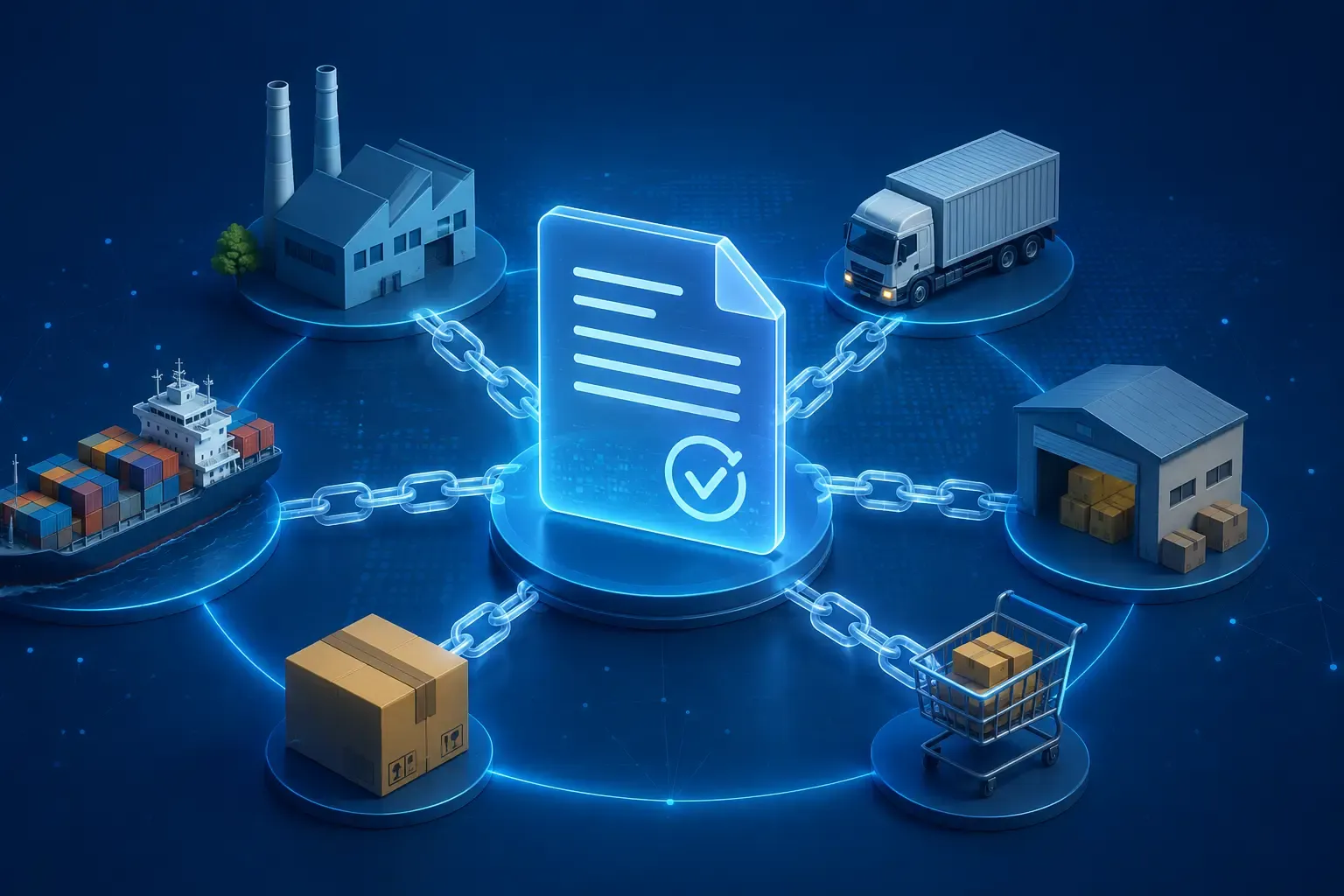
Smart contracts supply chain traceability works by recording every product event manufacture, transfer, inspection, delivery as an immutable transaction on a shared blockchain ledger. Here’s how the flow works in practice:
1. Product Onboarding and Provenance
Each product or batch is assigned a unique digital identity typically via RFID tags, QR codes, or IoT sensors at the point of origin. When the item is created or sourced, a smart contract records this as the “genesis event” on the blockchain.
This first entry captures:
- Supplier identity and location
- Raw materials used and their origins
- Production timestamp and batch ID
- Relevant certifications (organic, fair-trade, ISO, etc.)
2. Transfer of Custody
Every time goods change hands from factory to freight forwarder, from port to warehouse, from distributor to retailer a blockchain supply chain tracking event is recorded. The smart contract validates that the receiving party has accepted the goods and logs the precise time, location, and condition of transfer.
If goods are damaged, the smart contract can automatically trigger an insurance claim or dispute process, without waiting for paperwork.
3. Condition Monitoring with IoT Integration
When integrated with IoT sensors, smart contracts become even more powerful. Sensors continuously monitor temperature, humidity, vibration, and other parameters. If a threshold is breached, the smart contract:
- Logs the violation on-chain with a timestamp
- Notifies relevant parties automatically
- Adjusts payment terms if contractual SLAs are violated
This is especially critical in pharmaceuticals, fresh produce, and chemical supply chains where condition compliance is legally mandated.
4. Customs and Regulatory Compliance
Cross-border shipments involve mountains of documentation – certificates of origin, bills of lading, letters of credit, customs declarations. Smart contracts on supply chain traceability blockchain platforms can automate the verification and submission of these documents, reducing clearance times from days to hours.
5. End-to-End Audit Trail
At any point, whether for a regulatory audit, a product recall, or a quality dispute – any stakeholder with appropriate permissions can query the blockchain to see the complete, verified history of any product. This level of transparency is simply impossible with traditional ERP systems.
Smart Contracts for Asset Tracking: Going Beyond Products
While product traceability often gets the spotlight, smart contracts for asset tracking is equally transformative for enterprises managing high-value physical assets – machinery, vehicles, containers, tools, and infrastructure components.
Real-Time Asset Location and Status
By combining blockchain with GPS and RFID, enterprises can see exactly where every asset is, who has custody, and what condition it’s in real time. The blockchain asset tracking ledger provides a single source of truth that every party trusts because no single party controls it.
Predictive Maintenance Triggers
Smart contracts can be programmed to automatically trigger maintenance work orders when an asset reaches a certain usage threshold or when sensor data indicates wear. This shifts maintenance from reactive to predictive, reducing unplanned downtime and extending asset life.
Asset Lifecycle Management
Every event in an asset’s lifecycle purchase, deployment, transfer, repair, and retirement is recorded on-chain. This creates a permanent, auditable history that proves compliance, supports insurance claims, and simplifies asset disposal.
Leasing and Utilization Agreements
For assets that are leased between companies or shared across business units, smart contracts automate the billing, access control, and compliance monitoring. When a lease period ends, access permissions are automatically revoked, no manual intervention required.
Key Benefits of Blockchain-Based Supply Chain Management
The case for blockchain-based supply chain management extends well beyond technology novelty. Here are the tangible business outcomes enterprises can expect:
Reduced Operational Costs
Eliminating manual reconciliation, paperwork, and intermediaries can reduce supply chain administrative costs by 20–30%. Smart contracts compress settlement cycles from weeks to minutes.
Improved Supplier Accountability
When every supplier action is recorded on an immutable ledger, accountability is automatic. Buyers can enforce SLAs digitally and trigger financial penalties or bonuses based on real performance data.
Faster Dispute Resolution
Disputes that previously required lengthy investigations are resolved by simply querying the shared ledger. Both parties see the same data, making it much harder to deny responsibility.
Enhanced Consumer Trust
Brands can offer consumers the ability to scan a QR code and trace their product’s complete journey from farm to shelf, or factory to doorstep. This transparency is increasingly a competitive differentiator, especially in food, luxury goods, and pharmaceuticals.
Regulatory Compliance
Industries like pharmaceuticals, food, aerospace, and automotive face strict traceability mandates. Supply chain traceability blockchain systems create compliance-ready records that satisfy regulators without the burden of manual reporting.
Counterfeit Prevention
Because every product event is recorded on an immutable chain, introducing counterfeit goods into a verified supply chain becomes virtually impossible. Any item without a verifiable blockchain provenance can be flagged automatically.
Industry Applications of Smart Contracts in Supply Chains
Food and Agriculture
Farm-to-table traceability has become a regulatory requirement in many markets. Smart contracts for supply chain systems in food allow retailers to trace contamination to its source within seconds, not days, protecting consumers and limiting recall scope.
Pharmaceuticals
Drug serialization mandates require detailed tracking of every medicine unit from manufacturer to pharmacy. Blockchain-based systems ensure compliance while preventing counterfeit medicines from entering the supply chain.
Automotive and Manufacturing
Complex multi-tier supplier networks in automotive manufacturing benefit enormously from blockchain supply chain tracking. OEMs can verify that every component meets quality and sourcing requirements before it reaches the assembly line.
Logistics and Transportation
For logistics companies, blockchain asset tracking of containers, pallets, and vehicles reduces loss, improves fleet utilization, and creates verifiable proof-of-delivery records that speed up billing and dispute resolution.
Rayblaze has extensive experience building Smart IoT & Blockchain Solutions for enterprise transportation and logistics companies. Our work with logistics clients, including the revolutionizing trucking operations case study, demonstrates how smart technology creates measurable operational improvements.
Retail and E-Commerce
Retailers use smart contracts supply chain traceability to verify product authenticity, manage returns efficiently, and provide customers with verified provenance information, particularly for luxury goods and premium brands.
Technical Architecture of a Blockchain Supply Chain System
Understanding the technical building blocks helps enterprises evaluate what a real implementation looks like.
Blockchain Platform Selection
The choice of blockchain platform depends on enterprise requirements:
- Hyperledger Fabric – Permissioned blockchain ideal for enterprise supply chain consortiums where participants are known and governance is controlled
- Ethereum / Polygon – Suitable for public traceability use cases or where consumer-facing verification is required
- Quorum / Corda – Privacy-focused platforms popular in financial supply chain applications
Smart Contract Development
Smart contracts are written in platform-specific languages (Solidity for Ethereum, Go/JavaScript for Hyperledger Fabric) and define the business rules for every supply chain event. Well-designed contracts are modular, upgradeable, and rigorously audited before deployment.
Integration Layer
Connecting smart contracts to existing enterprise systems – ERP, WMS, TMS – requires a robust integration layer. APIs bridge the blockchain layer with SAP, Oracle, or custom enterprise platforms, ensuring that blockchain-based supply chain management enhances rather than replaces existing workflows.
Oracle Networks
Smart contracts cannot access real-world data on their own, they need “oracles” to feed in external information like GPS coordinates, IoT sensor readings, weather data, or customs status. Chainlink and similar oracle networks provide this bridge securely.
Identity and Access Management
In enterprise supply chains, not all participants should have access to all data. Role-based access controls ensure that suppliers see their own data, logistics providers see shipment data, and regulatory bodies see compliance data without exposing commercially sensitive information.
Challenges to Consider Before Implementation
Smart contracts for supply chain technology is powerful, but enterprises should go in with realistic expectations about the challenges:
Data Quality at the Source: Blockchain can only be as reliable as the data entered into it. If a supplier scans a counterfeit label onto the blockchain, the record is accurate but the product is not. Physical verification processes must complement digital ones.
Consortium Building: A blockchain supply chain only delivers full value when all key participants suppliers, logistics partners, customs authorities are on the same platform. Building that consortium requires significant change management.
Legacy System Integration: Connecting blockchain platforms with legacy ERP and WMS systems can be technically complex and requires experienced integration partners.
Regulatory Uncertainty: In some jurisdictions, the legal status of smart contract execution is still evolving. Smart legal teams should review contract enforceability.
Scalability: High-throughput supply chains processing millions of events per day require carefully architected blockchain solutions to avoid performance bottlenecks.
Working with an experienced blockchain-based supply chain management development partner helps enterprises navigate these challenges without costly trial-and-error.
How to Get Started: A Phased Approach
The most successful blockchain supply chain tracking implementations don’t try to boil the ocean. A phased approach delivers faster ROI and reduces implementation risk:
Phase 1 – Pilot Proof of Concept: Select a single product line, supplier relationship, or asset category to pilot. Define 3–5 smart contract use cases with clear, measurable outcomes.
Phase 2 – Integration and Expansion: Connect the blockchain system to existing ERP and logistics platforms. Onboard additional suppliers and expand to more product categories.
Phase 3 – Ecosystem Scale: Invite more supply chain partners onto the platform. Introduce consumer-facing traceability features and open up compliance reporting automation.
Phase 4 – Advanced Analytics: Layer AI and predictive analytics on top of the blockchain data to identify supply chain risks, optimize routes, and forecast disruptions before they happen.
Rayblaze’s Intelligent Data & AI Analytics services are specifically designed to unlock the value of enterprise data at this stage and turning blockchain transaction records into actionable business intelligence.
Why Choose Rayblaze for Blockchain Supply Chain Development?
At Rayblaze, we are a custom enterprise software development company with deep expertise in Smart IoT & Blockchain Solutions for Enterprise clients. Our end-to-end capabilities span:
- Smart contract development and auditing across Hyperledger Fabric, Ethereum, and Polygon
- IoT integration for real-time sensor data feeds into blockchain systems
- ERP and WMS integration connecting blockchain layers with SAP, Oracle, and custom platforms
- AI-powered analytics layered on top of blockchain data for predictive insights
- Digital Transformation & AI Implementation to guide your organisation through every stage of change
We serve enterprises across Transportation & Logistics, Retail & E-Commerce, Healthcare, and manufacturing industries where supply chain traceability is not optional.
Our AI-first approach means we don’t just build blockchain systems we build intelligent blockchain systems that learn, adapt, and grow with your business.
The era of opaque, fragmented, paper-driven supply chains is ending. Smart contracts for supply chain management represent a fundamental shift from reactive, manual processes to proactive, automated, and verifiable systems that every stakeholder in your network can trust.
Whether your priority is supply chain traceability blockchain for regulatory compliance, blockchain asset tracking for operational efficiency, or smart contracts supply chain traceability for consumer transparency, the technology exists today to transform how your supply chain operates.
Blockchain-based supply chain management is no longer a future investment, it’s a present-day competitive advantage.
Ready to explore what a smart contract-powered supply chain could look like for your business? Contact the Rayblaze team today for a free strategy consultation. Our blockchain and IoT experts will assess your current supply chain architecture and design a roadmap to measurable transformation.