Critical PHP Vulnerabilities: What Every Organisation Running PHP Needs to Do Now
The NSA’s PHP Security Alert: What It Is, Why It Matters, and How to Respond
On October 21, 2026, the NSA’s cybersecurity division issued an urgent public advisory: all organisations running PHP-based systems should prepare immediately for an update addressing two critical vulnerabilities. The advisory did not mince words; if an immediate update is not feasible, systems should be taken offline until fully mitigated. PHP powers a significant portion of the web, including millions of business websites, e-commerce platforms, CRMs, and enterprise applications. If your organisation has a website or web application built on WordPress, Drupal, Laravel, Magento, or any other PHP-based framework, this alert applies to you. We have been tracking these vulnerabilities since they were first disclosed. This post breaks down what they are, what they risk, and how an organisation with the right technical capability should respond.Understanding the Two Vulnerabilities
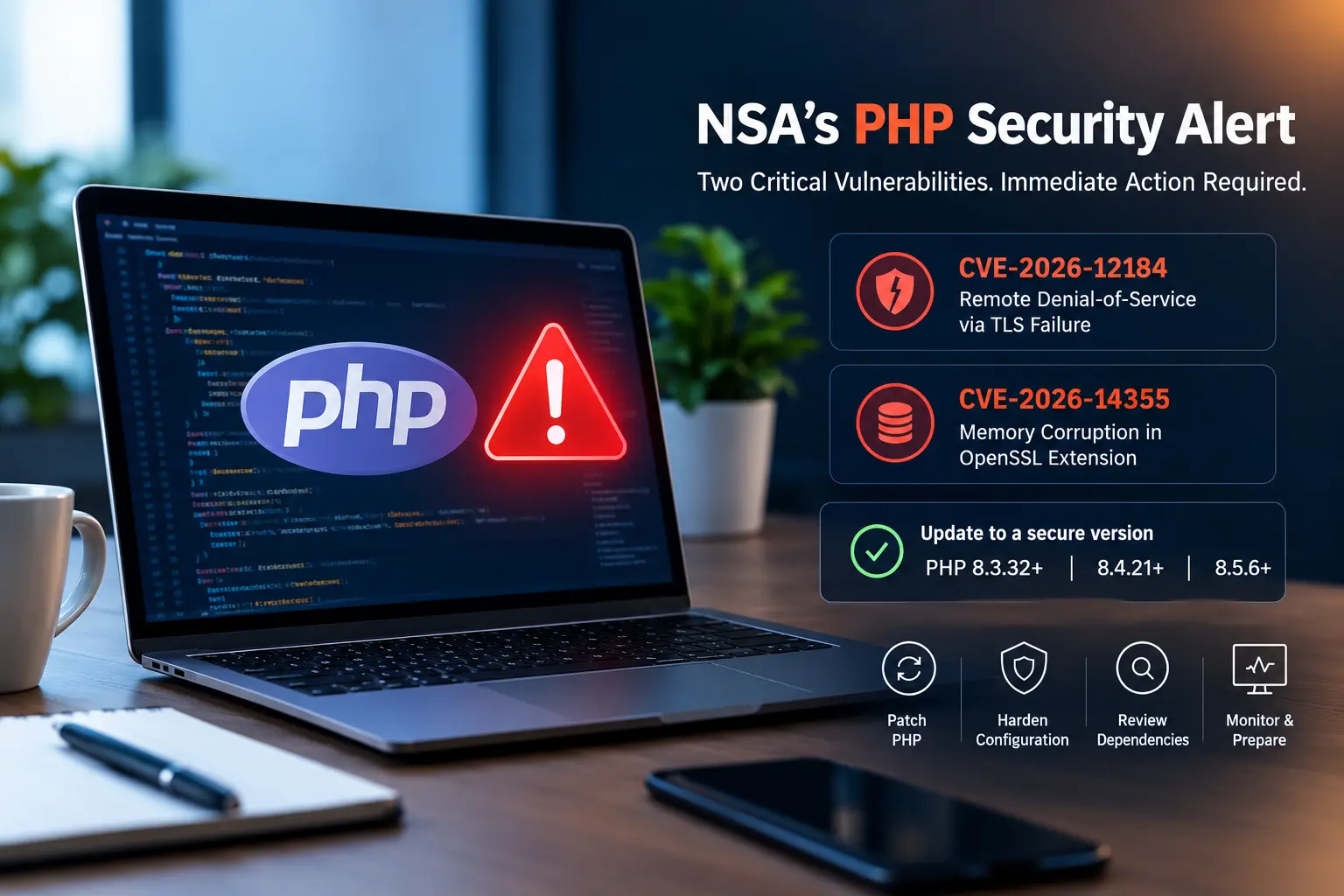
The NSA advisory is linked to two CVEs affecting PHP versions prior to 8.3.32, 8.4.21, and 8.5.6:CVE-2026-12184: Remote Denial-of-Service via TLS Failure
This vulnerability exploits a flaw in PHP’s HTTP stream-handling logic during TLS (SSL) initialisation failures. An attacker can remotely trigger a crash of the PHP FastCGI Process Manager (PHP-FPM), taking down the entire process pool and rendering the web application unavailable. In practical terms, a skilled attacker can knock a website offline at will.CVE-2026-14355: Memory Corruption in OpenSSL Extension
This vulnerability arises from improper buffer sizing within PHP’s OpenSSL extension, leading to memory corruption. Corrupted memory can be exploited to gain unauthorised access to the server’s file system or database, which is exactly what the NSA advisory flagged as the primary risk. This is a direct path to data exfiltration, credential theft, or a full system compromise. Both vulnerabilities have been confirmed in official PHP security advisories and have patches available. The exposure window for systems that have not yet updated is active and growing.Why This Is a Business Problem, Not Just a Technical One
Most business owners think of a cyberattack as an IT problem. The NSA’s intervention in this case signals something more serious: these vulnerabilities are straightforward enough to exploit that agencies responsible for national cybersecurity felt compelled to issue a public warning. For businesses, the risks translate directly:- Data breach and regulatory exposure: A successful exploit of CVE-2026-14355 gives an attacker read access to your database. For businesses operating in North America, the EU, or Australia, that means potential GDPR, PIPEDA, or Privacy Act violations, each carrying significant penalties.
- Website downtime and revenue loss: CVE-2026-12184 can crash your entire application stack with a targeted request. For e-commerce sites, service platforms, and SaaS products, every minute of downtime has a measurable cost.
- Customer trust and brand reputation: A breach is public. Whether it’s a notification letter or a news story, the reputational damage from a preventable attack far exceeds the cost of patching it.
- Supply chain exposure: If your platform serves enterprise clients or operates within a larger technology ecosystem, an unpatched vulnerability in your stack can become a vector into your clients’ systems, a liability most enterprise contracts explicitly address.
How to Respond Effectively, and What It Takes to Do It Right
Responding to a vulnerability of this severity requires more than running a package update. It demands a team that understands the full application stack (the runtime, the framework, the server configuration, and the codebase) and can act quickly across all of them. Here is what a thorough, well-executed response looks like in practice.Rapid Version Patching
Our development team works directly with server environments and PHP runtimes. We assess the specific PHP version running on each client’s infrastructure, apply the relevant patches (upgrading to PHP 8.3.32, 8.4.21, 8.5.6 or later as appropriate), and verify that application behaviour is unaffected after the update. This is a deterministic, low-risk process when handled by a team that knows the runtime, and a significant risk when left to guesswork.Application-Level Security Review
Patching the runtime is necessary, but not sufficient. We conduct a targeted review of the application layer to identify any code paths that interact with PHP’s TLS stream handling or OpenSSL extension in ways that could compound the risk or introduce residual exposure.Server Configuration Hardening
Beyond PHP itself, we review PHP-FPM process pool configuration, web server settings (Nginx/Apache), and firewall rules to reduce the attack surface. Temporary mitigations, such as rate-limiting TLS-initialisation requests, can be put in place while patching is scheduled.Monitoring and Incident Response Readiness
For enterprise applications, we implement log-level monitoring to detect anomalous patterns consistent with active exploitation attempts against these CVEs. Awareness of an attempt in progress is the difference between containment and a breach.Deep Codebase Familiarity
For custom PHP applications, the patch assessment is only as good as the team’s knowledge of the codebase. Our engineers work with full visibility into the dependency tree, which means a precise, targeted response rather than a blanket update that may introduce regressions.What to Do Right Now
If your website or application runs on PHP, here is a straightforward checklist:- Check your PHP version: Log into your hosting control panel or ask your developer. PHP 8.3 below 8.3.32, PHP 8.4 below 8.4.21, and PHP 8.5 below 8.5.6 are all affected.
- Schedule the update immediately: If you have a managed hosting provider or a development partner, this should be raised as a priority ticket today.
- If patching is not immediately possible, restrict access: The NSA advisory specifically recommends taking the system offline if patching cannot happen quickly. If that is not viable, at minimum restrict external access to the affected endpoints at the firewall level.
- Audit your dependencies: PHP frameworks and plugins may bundle their own PHP binaries or have dependencies that invoke the OpenSSL extension. A runtime patch alone may not be enough if a plugin is running an older embedded version.
- Review your incident response plan: Know who to call if a breach is detected. If you do not have a plan, this is the moment to create one.