

Agentic AI Guardrails: How to Keep Autonomous AI Agents Safe, Secure and Under Control
Enterprises are moving fast from AI assistants that answer questions to AI agents that take action. These agents read emails, query databases, update records, trigger workflows and call external tools, often across several steps and with little human input. That shift creates real value, but it also changes the risk picture. When software can decide and act on its own, a single bad decision can touch customers, data and revenue before anyone notices.
This guide explains Agentic AI Guardrails in practical terms. It is written for CTOs, security leaders, product owners and engineering teams who want to deploy autonomous agents with confidence. You will learn what guardrails are, which risks they address, how to layer them, and how to build the monitoring and governance that keep them effective over time.
What Are Agentic AI Guardrails?
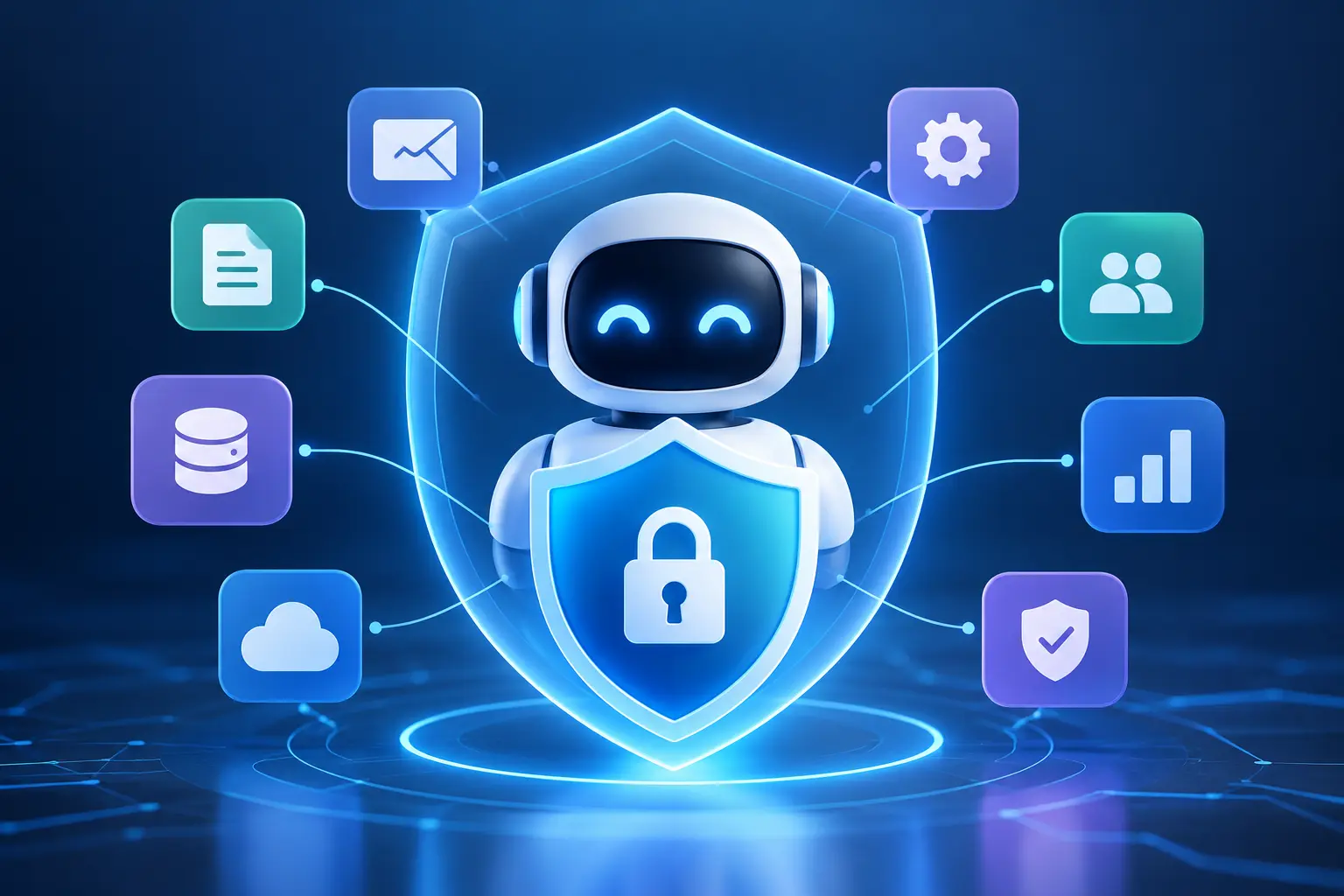
Agentic AI guardrails are the technical controls, policies and oversight mechanisms that define what an AI agent is allowed to do, what it must never do, and when a human must step in. They apply across the full lifecycle of an agent: how it receives instructions, how it plans, which tools it can call, what data it can see, and how its outputs are checked before they reach people or systems.
It helps to separate three related ideas. AI agent guardrails are the specific controls placed around an agent’s behavior. AI agent governance is the organizational layer of ownership, policy and accountability that decides which controls are required. Agentic AI safety is the broader goal of making sure agents behave reliably and do not cause harm, whether through error, misuse or attack. Strong programs treat all three as one connected system rather than separate projects.
Why Agentic AI Guardrails Matter More Than Chatbot Guardrails
Many teams assume the content filters they used for chatbots will be enough for agents. They are not, for three reasons.
Agents Act, Not Just Answer
A chatbot that produces a wrong answer creates a bad response. An agent that takes a wrong action can issue a refund, delete a record, send a message to a customer or change a configuration. The cost of an error moves from embarrassment to operational impact.
Agents Chain Decisions Together
Agents break goals into steps, and each step depends on the last. A small misunderstanding early in the chain can compound into a large failure by the end. Guardrails therefore need to work at every step, not only at the final output.
Agents Connect to Real Systems
Useful agents need access to calendars, CRMs, ERPs, payment tools and internal knowledge bases. Every connection is also a possible path for misuse, which makes Agentic AI security a first-order design concern rather than an afterthought.
The Main Risks Guardrails Must Address
Before choosing controls, it helps to name the risks. These are the ones that appear most often in enterprise agent deployments:
- Prompt injection and manipulation. Malicious instructions hidden in emails, web pages, documents or tool outputs can trick an agent into ignoring its original task. Because agents read untrusted content as part of their work, this is one of the most important threats to design for.
- Excessive permissions. Agents given broad access “to be safe” can do far more damage than intended if they are misled or make a mistake. Excessive agency is widely recognized as a core risk category for LLM applications.
- Tool misuse and unintended actions. An agent may call the right tool with the wrong parameters, or call a tool at the wrong time, producing results nobody approved.
- Data leakage. Agents that can see sensitive data may expose it in outputs, logs or messages to external services.
- Goal drift and runaway loops. Agents can pursue a goal in ways that technically satisfy it but violate business intent, or repeat actions endlessly and drive up cost.
- Cascading errors in multi-agent systems. When agents pass work to other agents, one faulty output can spread through the whole workflow.
- Hallucinated actions. Agents can invent facts, tool names or records, and then act on them as though they were real.
Core Layers of Agentic AI Guardrails
No single control is enough. Effective Agentic AI Guardrails work in layers, so that when one layer fails another catches the problem. The layers below form a practical blueprint.
Input Guardrails
Input guardrails inspect what reaches the agent: user requests, retrieved documents, tool responses and messages from other agents. They screen for injection attempts, remove or flag sensitive data, and keep untrusted content clearly separated from trusted instructions. Treat everything the agent reads from outside your own system as untrusted by default.
Reasoning and Planning Guardrails
Before an agent acts, its plan can be checked against policy. Planning guardrails confirm that the proposed steps stay within the agent’s assigned scope, that the sequence is reasonable, and that high-impact steps are flagged. Limits on the number of steps, the time allowed and the budget available prevent runaway behavior.
Tool and Action Guardrails
This is where AI agent controls matter most. Each tool should be exposed with the narrowest possible permissions, strict input validation and clear allow lists. Read-only access should be the default, with write, delete and payment actions granted only where the use case demands it. Actions that cannot be undone deserve extra checks or approvals.
Output Guardrails
Outputs should be validated before they reach customers, employees or downstream systems. Checks can include format validation, policy and compliance screening, removal of personal data, and verification that claims are grounded in approved sources. Grounding agents in current company knowledge, for example through retrieval, also reduces fabricated answers. Our guide on RAG vs fine-tuning for enterprise AI explains how to choose the right approach.
Human-in-the-Loop Checkpoints
Not every action needs approval, but some always should. Define clear triggers for human review, such as actions above a financial threshold, changes to customer records, messages sent externally, or any case where the agent’s confidence is low. Make the approval step fast and informative, showing the reviewer what the agent plans to do and why. Approval flows that are slow or confusing quickly get bypassed.
Runtime Isolation and Fail-Safes
Run agents in sandboxed environments with limited network and file access. Build in rate limits, spending caps and an emergency stop that can pause a single agent or an entire fleet immediately. A kill switch that nobody has tested is not a real control, so rehearse it.
AI Agent Security: Protecting Identity, Data and Tools
AI agent security borrows many ideas from established security practice and applies them to a new kind of actor. A few principles carry most of the weight:
- Give every agent its own identity. Avoid shared service accounts. A distinct identity makes it possible to grant specific permissions, trace every action and revoke access quickly.
- Apply least privilege. Grant only the access needed for the current task, and prefer short-lived credentials over permanent keys.
- Protect secrets. Keep API keys and tokens out of prompts and logs, and store them in a managed secrets service.
- Segment data access. Limit which datasets each agent can read, and mask or tokenize sensitive fields where the agent does not need the raw value.
- Vet third-party tools. Every external tool, plugin or connected service expands the attack surface. Review them as you would any vendor with access to your systems.
- Test adversarially. Run red-team exercises that try to inject instructions, extract data and push agents beyond their scope, and fix what they find.
Strong Agentic AI security also depends on the quality of the underlying software. Agents inherit the weaknesses of the systems they connect to, so secure integration and clean APIs matter as much as the model itself. Rayblaze builds this foundation through its AI-focused custom enterprise software development practice.
AI Agent Monitoring and Observability
Guardrails that are set once and never checked will drift out of date. AI agent monitoring gives you the evidence to know whether controls are working and the early warning to act when they are not.
What to Monitor
- Full action traces. Record each prompt, plan step, tool call, parameter and result so any decision can be reconstructed later.
- Guardrail events. Track how often controls block, modify or escalate an action. A sudden change in these rates is a useful signal.
- Cost and usage. Watch token spend, tool call volume and loop counts to catch runaway behavior early.
- Quality and accuracy. Sample outputs regularly and score them against defined standards.
- Anomalies. Flag unusual access patterns, new tool combinations, off-hours activity and unexpected data requests.
Turn Monitoring Into Action
Monitoring only helps if someone responds. Set alert thresholds, name an owner for each agent, and define an incident process that covers pausing the agent, investigating, fixing and reporting. Keep immutable audit logs, because regulated industries will need them to demonstrate accountability.
AI Agent Governance: Ownership, Policy and Accountability
Technical controls need organizational structure around them. AI agent governance answers questions such as: who approves a new agent, who owns it once it is live, what data it may use, and what happens when it fails.
- Clear ownership. Every agent should have a named business owner and a named technical owner.
- An agent inventory. Keep a living register of every agent in use, including its purpose, permissions, data sources and risk tier. Unregistered “shadow agents” are a growing problem.
- Approval and change management. Treat changes to prompts, tools, models and permissions as controlled changes with review and testing, not casual edits.
- Policy that people can follow. Write short, specific rules about acceptable use, data handling and escalation, and train the teams who build and operate agents.
- Alignment with recognized frameworks. Frameworks such as the NIST AI Risk Management Framework and ISO/IEC 42001 offer useful structure, and regulations such as the EU AI Act may apply depending on where and how you operate. Confirm your specific obligations with legal and compliance advisers.
Agentic AI Risk Management: Match Controls to Impact
Applying maximum controls to every agent would make most of them unusable. Effective Agentic AI risk management sorts agents into tiers based on what could go wrong, then scales the guardrails to match.
Low-Risk Agents
These work with public or low-sensitivity information and take reversible actions, such as drafting internal summaries or tagging tickets. Light input and output checks, standard logging and periodic sampling are usually enough.
Medium-Risk Agents
These touch internal systems or customer-facing channels but with limited authority, such as responding to routine support requests or updating non-critical records. Add stricter tool permissions, policy screening of outputs, anomaly alerts and human review for exceptions.
High-Risk Agents
These handle money, regulated data, safety-relevant decisions or irreversible actions. They need the full stack: tight least-privilege access, mandatory human approval for defined actions, sandboxing, detailed audit trails, adversarial testing before launch and continuous monitoring after it.
Revisit tiers regularly. An agent that begins as low-risk can quietly become high-risk as new tools and permissions are added over time.
Agentic AI Guardrails Across Enterprise Industries
The right guardrails depend on the sector. Here is how priorities typically differ across the industries Rayblaze serves:
Healthcare
Agents that support triage, scheduling or documentation handle highly sensitive data and can influence patient outcomes. Priorities include strict data access controls, clinician approval for anything clinical, traceable sources and detailed audit logs. Rayblaze builds healthcare software solutions that balance automation with patient safety and regulatory traceability.
Retail and E-Commerce
Agents handling refunds, pricing, promotions and customer messages need spending limits, brand and policy checks on outputs, and safeguards against manipulation by customers or hostile content. Rayblaze’s retail and e-commerce solutions combine personalization with controls that protect margin and trust.
Transportation and Logistics
Agents supporting dispatch, routing and compliance work with live operational data where delays and errors are costly. Priorities include action limits, real-time monitoring and clear escalation to human dispatchers. See how Rayblaze approaches transportation and logistics software with AI at its core.
Education
Agents acting as tutors or administrative assistants must protect student data and keep content age-appropriate and accurate. Rayblaze’s education technology solutions reflect these needs.
Real Estate
Agents working with listings, valuations and client communication need accuracy checks, data privacy controls and review of anything that carries legal or financial weight. Explore Rayblaze’s real estate software solutions to see how this works in practice.
Common Mistakes in Agentic AI Guardrails
Relying on the Prompt Alone
Telling an agent in its instructions to “never share confidential data” is a request, not a control. Prompts can be overridden or ignored, so critical rules must be enforced in code, permissions and infrastructure.
Granting Broad Access Up Front
Teams often start with wide permissions to get a demo working and never tighten them. Begin narrow and expand only when the evidence supports it.
Guarding Outputs but Not Actions
Screening what an agent says is not the same as controlling what it does. Many serious incidents involve a tool call, not a sentence.
Skipping Process Clarity
If the underlying business process is unclear, an agent will automate the confusion. Map the workflow first, as described in our guide on mapping business processes before automating them.
Treating Guardrails as a One-Time Project
Models change, tools change and attackers adapt. Guardrails need regular testing, tuning and review, just like any other security control.
How to Implement Agentic AI Guardrails: A Practical Roadmap
- Define the agent’s job precisely. Write down its goal, boundaries and actions explicitly not allowed to take.
- Classify the risk. Assign a risk tier based on data sensitivity, reversibility and business impact.
- Design permissions first. Create a dedicated identity, apply least privilege and limit tools to the minimum needed.
- Add layered controls. Implement input, planning, tool, output and human-approval guardrails appropriate to the tier.
- Test before launch. Run functional tests, edge cases and adversarial red-team exercises, and record the results.
- Launch in stages. Start with limited scope or shadow mode, where the agent recommends and humans act, before granting more autonomy.
- Monitor and respond. Turn on full tracing, alerts and an incident process from day one.
- Review and improve. Revisit permissions, thresholds and tiers on a regular schedule and after every incident.
If your organization is planning its first production agent, or reviewing ones already running, Rayblaze can help you design the architecture and controls before problems appear. Our Digital Transformation & AI Implementation practice supports teams embedding AI into core workflows, and our AI Consulting service helps you assess risks, choose the right level of autonomy and plan a safe rollout.
Conclusion
Autonomy is what makes AI agents valuable, and it is also what makes them risky. The goal of Agentic AI Guardrails is not to slow agents down but to give them clear limits so they can be trusted with meaningful work. The strongest programs layer controls across inputs, planning, tools and outputs, enforce least privilege, keep humans in the loop where it counts, and back everything with AI agent monitoring and clear governance.
Whatever your industry, the principle is the same: grant autonomy in proportion to the safeguards you have in place, and expand it only as your evidence grows. That is the foundation of dependable Autonomous AI safety in the enterprise.
Rayblaze builds enterprise AI systems that are designed for production from day one, with security, oversight and accountability built in.