Python Security: Common Vulnerabilities and Best Practices for Secure Development
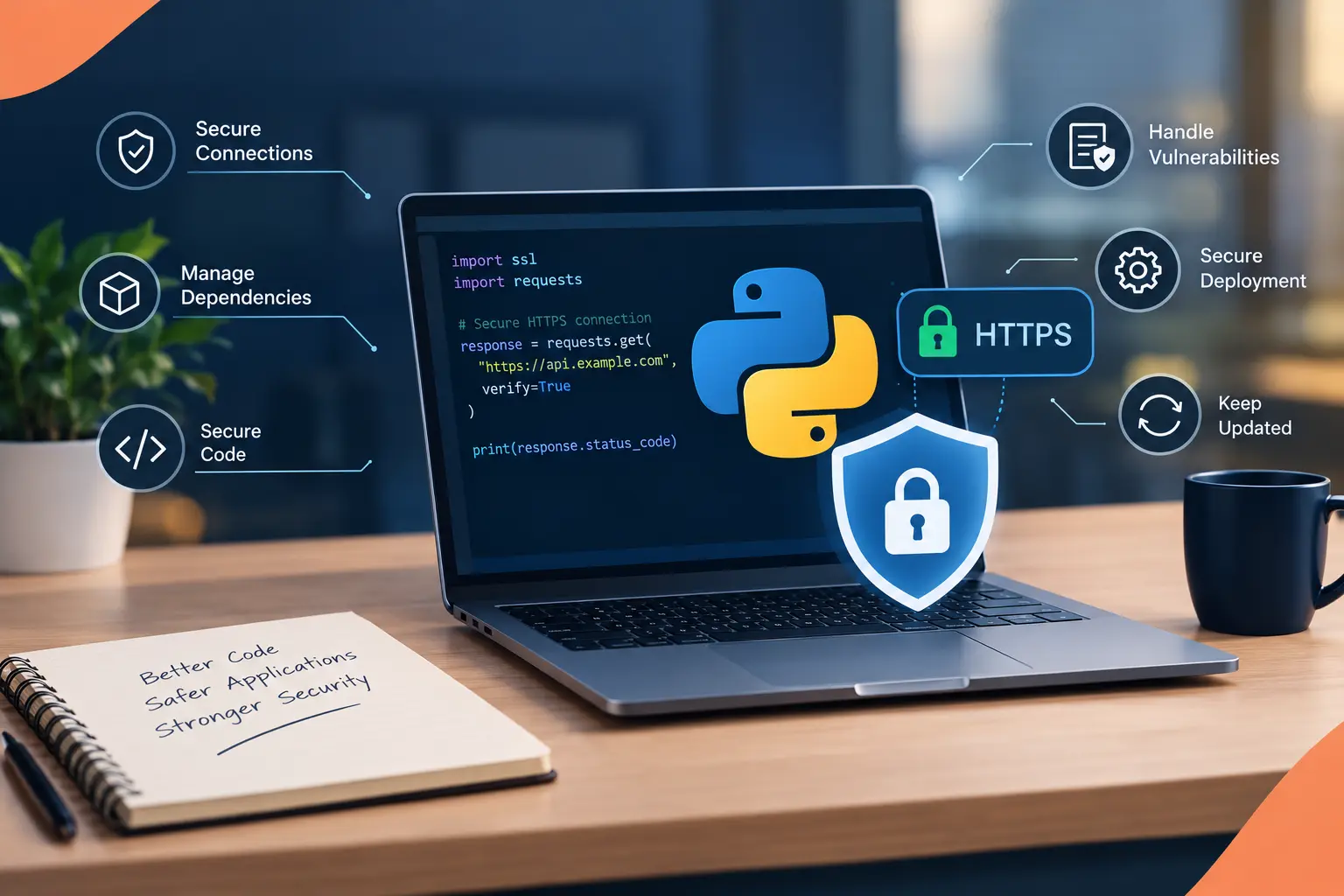
Python Security Requires More Than Writing Secure Code
Python is widely used to develop web applications, APIs, automation tools, data platforms and AI applications. Its extensive ecosystem helps teams build software efficiently, but it also introduces security considerations that extend beyond the application code itself.
Third-party libraries, HTTPS configurations, package installation processes and deployment environments all influence an application’s security. A vulnerability in any of these areas can expose business data, disrupt operations or create opportunities for unauthorised access.
For organisations running Python applications in production, security should be part of the entire software development lifecycle. This includes identifying vulnerabilities, maintaining dependencies, configuring secure connections and ensuring that updates reach every environment where the application runs.
The goal is not simply to prevent security issues during development. It is to establish a consistent process for identifying and addressing risks as software, infrastructure and dependencies evolve.
Recent Security Concerns
Recent security scares involving compromised certificate authority keys have highlighted an important risk for Python development teams: secure HTTPS connections depend on more than encryption alone. Applications must also validate server certificates correctly, use trusted certificate sources and keep their security components up to date.
For teams using Python to build web applications, APIs, automation tools and AI solutions, these concerns extend beyond a single security incident. Outdated dependencies, misconfigured TLS settings and unpatched development environments can all introduce vulnerabilities. Updating the operating system alone may not address every issue, particularly when Python tools or applications rely on separate certificate stores.
Understanding how these components work together is essential for maintaining secure applications. This article explores common Python security risks and practical steps development teams can take to strengthen HTTPS protection, manage dependencies and build security into their software development lifecycle.
Understanding HTTPS Certificate Validation
HTTPS protects information exchanged between a client and a server through encrypted communication. Certificate validation helps the client verify the server’s identity and establish trust in the connection. Python applications commonly use the built-in ssl module to support TLS connections. Package-management tools such as pip also rely on HTTPS when downloading dependencies from online repositories.
Security problems can arise when certificate validation is disabled, trusted certificates are misconfigured, outdated software remains in use or a client fails to validate the server correctly. For example, if an application accepts an invalid certificate without proper verification, an attacker positioned to intercept network traffic may be able to impersonate the intended server. Depending on the circumstances, this could expose sensitive information or allow data exchanged with the application to be manipulated.
Development teams should keep certificate verification enabled and investigate the underlying cause of TLS errors rather than bypassing security checks to make a connection work. They should also understand how their Python runtime, package-management tools, operating system and deployment environment manage trusted certificates. These components can use different configurations or certificate sources, so updating one does not necessarily resolve every issue.
For implementation guidance, consult the official Python SSL documentation and pip HTTPS certificate documentation.
Common Python Security Risks to Watch
1. Outdated and Vulnerable Dependencies
Python projects often rely on third-party packages to handle authentication, data processing, API communication and other functions. These dependencies can introduce vulnerabilities, particularly when they are no longer maintained or contain known security flaws.
Risks can also originate in transitive dependencies: packages required by the libraries an application directly uses.
Development teams should maintain an inventory of dependencies, monitor relevant security advisories and assess updates according to their severity and applicability. Automated vulnerability scanning can help identify affected packages, but findings still require technical review and prioritisation.
Where appropriate, teams should pin dependency versions, use reproducible installation processes and verify package integrity. Pinning versions improves consistency, but it does not make a vulnerable package safe; dependencies must still be reviewed and updated.
The official pip secure installation guide explains how hash-checking mode can help verify that downloaded packages match expected hashes.
2. Weak HTTPS and TLS Configuration
Applications that disable certificate verification, use inappropriate TLS settings or rely on outdated security components may be vulnerable to interception or other connection-related attacks. A common mistake is to disable certificate verification when a development environment encounters a certificate error. Although this may temporarily resolve the connection problem, it removes an important security safeguard.
Teams should instead investigate certificate chains, trust-store configuration, proxy settings and supported TLS versions. They should also review the configuration of HTTP clients and external integrations used by the application.
Secure defaults should be maintained across development, testing and production environments. Any exception should be justified, narrowly scoped and reviewed.
3. Insecure Secrets Management
Applications frequently require credentials such as API keys, database passwords, access tokens and encryption keys. Storing these directly in source code or committing them to a repository can expose systems to unauthorised access.
A safer approach is to use environment-specific configuration and an appropriate secrets-management solution. Access should follow the principle of least privilege, giving each application and service only the permissions it needs.
Teams should also prevent secrets from appearing in application logs, build output and error messages. If a credential is exposed, removing it from the source code alone is insufficient; the credential should be revoked or rotated and the exposure investigated.
4. Insecure Input Handling
Python applications often process data from users, external APIs, uploaded files and other systems. If this data is handled unsafely, it can introduce vulnerabilities such as injection attacks, path traversal or unauthorised access. Input validation should be appropriate to the expected data type, format and business rules. Database operations should use parameterised queries rather than constructing SQL statements through string concatenation.
Developers should also avoid evaluating untrusted input as code and should not deserialize untrusted data using unsafe mechanisms. For example, Python’s pickle module can execute arbitrary code during deserialization and should not be used with untrusted data.
Output encoding, appropriate access controls, safe file-handling practices and security testing provide additional layers of protection. The OWASP Top 10:2025 provides a broader framework for understanding application security risks, including injection, security misconfiguration and broken access control.
5. Insecure Build and Deployment Pipelines
Application security does not end when the code passes testing. Build systems, CI/CD pipelines, container images and package repositories can introduce risks if they are not properly maintained and protected.
For example, a deployment pipeline with excessive permissions or exposed credentials could allow unauthorised changes to application code or production infrastructure. An outdated container image may also retain vulnerable system packages or Python dependencies.
Organisations should restrict pipeline permissions, protect repository access, manage build secrets securely and scan dependencies and container images for known vulnerabilities.
They should also establish a clear process for rebuilding and redeploying affected environments after security updates. Updating a developer’s workstation does not automatically update a production container or an independently maintained build runner.
The OWASP guidance on software supply chain failures offers further recommendations for securing dependencies, build systems and software distribution processes.
Why Updating Python Alone Will Not Help
Keeping Python updated is an essential security measure, but it does not automatically address every vulnerability in an application.
Security depends on several interconnected components, including:
- Python runtime: The interpreter and its standard library must receive applicable security fixes.
- Third-party dependencies: Libraries and transitive packages need to be monitored for vulnerabilities and maintained.
- HTTPS and TLS configuration: Certificate validation and connection settings must remain secure.
- Operating system and containers: System packages, base images and supporting software need their own maintenance processes.
- Build and deployment infrastructure: CI/CD pipelines, package sources, credentials and deployment permissions must be protected.
Consider a Python application that runs on a fully updated server but still depends on a vulnerable third-party library. The operating system update alone will not fix that library. Similarly, updating a package in a developer’s local environment does not guarantee that the production environment is using the corrected version.
A practical security process should identify the components used by each application, assess relevant vulnerabilities, apply appropriate updates, test compatibility and confirm that the fixes reach deployed environments.
This approach helps teams move beyond isolated patching towards a repeatable software maintenance process.
A Practical Python Security Checklist
Engineering teams can use the following checklist to review their Python development and deployment practices.
- Establish a process for monitoring security advisories and prioritising remediation.
- Scan container images and rebuild affected environments after updates.
- Protect source repositories, CI/CD credentials and deployment permissions.
- Avoid unsafe deserialization and execution of untrusted input.
- Validate external input and use parameterised database queries.
- Store credentials and API keys outside application source code.
- Investigate TLS errors instead of disabling security checks.
- Keep HTTPS certificate verification enabled.
- Inventory direct and transitive dependencies and scan for known vulnerabilities.
- Maintain pip, uv and other package-management tools.
- Use a supported Python version and apply relevant security updates.
The controls required will depend on the application’s architecture, the sensitivity of its data, its external integrations and the environments in which it operates. This checklist is a starting point rather than a substitute for a security assessment.
Building Security Into Python Development
Python security is an ongoing engineering responsibility. Secure coding practices, dependency maintenance, infrastructure configuration and deployment controls need to work together throughout an application’s lifecycle.
Organisations can strengthen their approach by incorporating security reviews into development workflows, automating appropriate checks and assigning clear responsibility for remediation. Regular testing can help identify weaknesses before they affect production systems.
For business-critical applications, the objective should be to make security part of routine development and maintenance rather than treating it as a separate activity performed only after an incident.
A structured approach helps teams respond more consistently to emerging vulnerabilities, maintain application reliability and reduce avoidable security risks as their software evolves.
How Rayblaze Can Help
Rayblaze helps organisations develop and maintain business applications, integrate systems and improve their digital infrastructure. Security considerations can be incorporated into application development, dependency management and deployment workflows to support reliable software operations.
For organisations building new Python applications or reviewing existing systems, our team can help assess application requirements, development practices and infrastructure considerations to identify areas for improvement.
Planning a new application or reviewing an existing system? Contact Rayblaze to discuss your software development and infrastructure requirements.
Frequently Asked Questions
Is Python a secure programming language?
Python can be used to build secure applications, but security depends on how the application is designed, implemented, configured and maintained. Vulnerable dependencies, unsafe input handling and weak access controls can introduce risks regardless of the programming language.
How often should Python dependencies be updated?
Teams should monitor security advisories continuously and assess updates according to severity, exposure and applicability. Critical vulnerabilities may require urgent remediation, while routine maintenance updates can follow a defined schedule. Updates should be tested for compatibility before deployment.
Does using HTTPS guarantee that a Python application is secure?
No. HTTPS protects data in transit when correctly configured, but it does not prevent vulnerabilities such as injection, broken access controls, exposed credentials or insecure dependencies. Application security requires multiple complementary controls.
How can developers check Python packages for known vulnerabilities?
Developers can use dependency auditing and software composition analysis tools to identify packages associated with known vulnerabilities. Results should be reviewed to establish whether the affected component is present, reachable and relevant to the application, then prioritised for remediation.
Why should organisations review their Python deployment pipelines?
Build and deployment pipelines handle source code, dependencies, configuration and often sensitive credentials. Restricting access, protecting secrets, scanning dependencies and maintaining deployment environments can reduce the risk of compromised software reaching production.
What is the difference between updating Python and updating its packages?
Updating Python maintains the interpreter and its included components, while updating packages maintains third-party libraries installed for an application. Both are important because vulnerabilities can affect either layer. Operating system packages and container images may require separate updates as well.
Technical note: Security recommendations and software behaviour can change between releases. Consult official documentation and relevant security advisories before implementing changes in production environments.