

RAG vs Fine-Tuning: Which AI Approach Is Right for Enterprise Software?
As enterprise teams move from AI experimentation to production deployment, one question keeps surfacing in architecture meetings and boardrooms alike: should we use Retrieval-Augmented Generation (RAG) or fine-tuning to get the most out of our AI systems? Both approaches promise to make large language models more useful for your specific business context but they work very differently, carry very different costs, and serve very different purposes.
This guide breaks down the RAG vs fine-tuning comparison in practical terms, helping enterprise decision-makers, CTOs, and software architects choose the right path or understand when to combine both.
What Is RAG (Retrieval-Augmented Generation)?
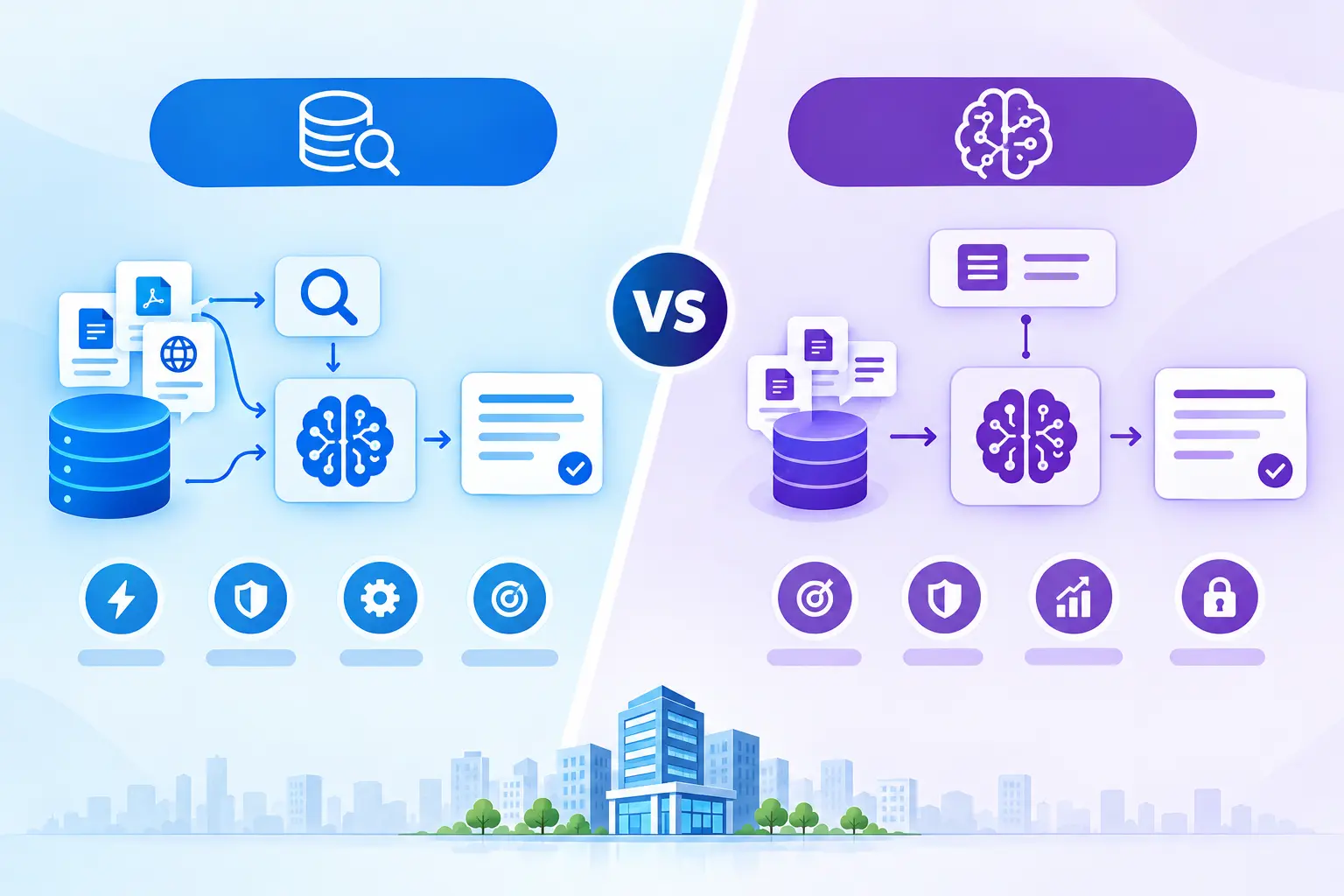
Retrieval-Augmented Generation is an architecture that enhances a large language model by connecting it to an external knowledge source at inference time. Instead of relying solely on what the model learned during training, RAG retrieves relevant documents, records, or data from a connected knowledge base and passes them into the model’s context window alongside the user’s query.
The model then generates its response based on both its pre-trained knowledge and the freshly retrieved information. The result is an AI system that can answer questions grounded in your current, company-specific data without retraining the underlying model.
A typical RAG pipeline in enterprise software includes:
- A document ingestion layer that processes and chunks your internal knowledge (PDFs, databases, wikis, CRM records, support tickets)
- An embedding model that converts text into vector representations
- A vector database (such as Pinecone, Weaviate, or pgvector) that stores and retrieves those vectors by semantic similarity
- A retrieval layer that fetches the most relevant chunks in response to a query
- A generation layer where the LLM produces a response grounded in the retrieved context
RAG is the default architecture for enterprise AI applications that need to work with proprietary, frequently updated, or domain-specific information from internal knowledge bases and policy documents to product catalogues and real-time operational data.
What Is Fine-Tuning?
Fine-tuning is the process of taking a pre-trained foundation model and continuing to train it on a curated dataset specific to your domain, use case, or organisation. The model’s weights are updated through this additional training, meaning the knowledge and behaviour patterns from your dataset become baked into the model itself not retrieved at runtime, but encoded at a parameter level.
Fine-tuning can be applied in several ways:
- Full fine-tuning: All model parameters are updated compute-intensive and expensive, but maximally expressive.
- Parameter-efficient fine-tuning (PEFT): Techniques like LoRA (Low-Rank Adaptation) or QLoRA update only a small subset of parameters, dramatically reducing computational cost while preserving most of the performance benefit.
- Instruction tuning: The model is trained on examples of desired input-output behaviour to align it with a specific task format or communication style.
Fine-tuning excels when you need the model to adopt a consistent tone, follow a specific output format, reason in a domain-specific way, or perform a specialised task reliably without needing to provide reference documents at every inference call.
RAG vs Fine-Tuning: The Core Differences
The fundamental distinction is this: RAG changes what the model knows at runtime by injecting external information. Fine-tuning changes what the model is by modifying its parameters during training. Everything else in the RAG vs fine-tuning comparison flows from that single difference.
Knowledge Update Frequency
RAG systems can be updated in near real time. Add a new document to your knowledge base and the model can reference it immediately, no retraining required. Fine-tuned models freeze their knowledge at the point of training. If your enterprise data changes frequently product inventory, compliance policies, case law, patient records RAG is almost always the right choice for keeping responses current.
Transparency and Traceability
RAG responses can be grounded with explicit citations, showing exactly which document or record the model drew from to generate an answer. In regulated industries healthcare, legal, financial services this auditability is not a nice-to-have; it is a compliance requirement. Fine-tuned models produce outputs that are harder to trace to a specific source, making explainability more challenging.
Cost and Infrastructure
RAG requires infrastructure investment upfront: a vector database, an embedding pipeline, document ingestion and chunking logic, and retrieval tuning. But once built, it scales relatively cost-effectively and does not require retraining when knowledge changes. Fine-tuning requires significant computation at training time particularly for full fine-tuning of large models and must be repeated whenever the underlying data changes substantially. For enterprise AI fine-tuning at scale, these costs compound quickly.
Behaviour vs Knowledge
This is perhaps the most practically important distinction in the retrieval augmented generation vs fine-tuning debate. Fine-tuning is better suited to changing how the model behaves: its tone, its reasoning style, its output format, its specialist vocabulary. RAG is better suited to changing what the model knows: the specific facts, policies, records, and documents it can draw on. Trying to use fine-tuning to inject factual knowledge often results in hallucination and inconsistency; the model learns patterns from the training data but does not reliably retain or retrieve specific facts.
Hallucination Risk
Counterintuitively, fine-tuned models trained on factual data can hallucinate more confidently than RAG-augmented models. Because the model has internalised patterns from the training data without being grounded to source documents at inference time, it may generate plausible-sounding but incorrect facts. RAG architectures constrain the model to the retrieved context, reducing though not eliminating hallucination on factual queries.
Latency
Fine-tuned models have lower inference latency because they require no retrieval step. RAG adds a retrieval round-trip to every query, which introduces latency that must be managed through efficient vector search, caching strategies, and infrastructure optimisation. For latency-sensitive enterprise applications real-time customer service, trading systems, live operational dashboards this trade-off matters.
When to Choose RAG for Enterprise AI
RAG is the right foundation for most enterprise software AI implementations where the use case involves:
- Frequently changing knowledge. Policy documents, product specs, compliance guidelines, pricing, and inventory are all examples of information that changes too fast to retrain a model around.
- Large proprietary knowledge bases. When the relevant context is too large to fit into a model’s context window at every query and too dynamic to encode through fine-tuning, RAG’s retrieval mechanism efficiently surfaces only what is needed.
- Regulatory and audit requirements. Any enterprise operating in a regulated environment that needs to show its AI decisions are grounded in specific, citable documents should default to RAG.
- Multi-domain enterprise systems. If your AI needs to serve multiple departments legal, HR, finance, operations each with their own knowledge base, RAG allows you to partition and route retrieval without training separate models for each domain.
- Rapid deployment timelines. RAG systems can be stood up significantly faster than fine-tuning pipelines, making them the practical choice when time-to-value is a priority.
Typical enterprise RAG use cases include internal knowledge assistants, customer support bots grounded in product documentation, contract review tools that reference legal databases, and compliance query systems tied to regulatory repositories.
At Rayblaze, our Digital Transformation & AI Implementation practice regularly architects RAG-based systems for enterprise clients that need to operationalise their internal knowledge at scale connecting proprietary data to production AI without the overhead of continuous retraining.
When to Choose Fine-Tuning for Enterprise AI
Enterprise AI fine-tuning earns its place in specific, well-defined scenarios where behaviour change rather than knowledge injection is the objective:
- Specialised domain reasoning. Medical diagnosis support, legal contract interpretation, financial risk modelling, and engineering code review all require reasoning patterns that differ substantially from a general-purpose model’s defaults. Fine-tuning on domain-specific examples trains the model to reason the way an expert in that domain would.
- Consistent output format. If your enterprise application requires the model to consistently return structured JSON, follow a specific reporting template, or produce outputs that integrate directly into a downstream system, fine-tuning on format-aligned examples is more reliable than prompting alone.
- Proprietary tone and communication style. Brand voice, regulatory communication norms, and internal communication conventions can be trained into a model through fine-tuning in a way that is difficult to achieve through prompting or RAG alone.
- Low-latency inference requirements. When retrieval latency is unacceptable in real-time or near-real-time systems a fine-tuned model that has internalised the relevant patterns without needing a retrieval step may be the right trade-off.
- Small, stable, high-value datasets. If your enterprise has a well-curated, relatively static dataset that encodes genuinely specialized knowledge, expert annotations, proprietary research, unique operational data, fine-tuning can embed that expertise into the model in a durable way.
Fine-tuning is also frequently used in conjunction with RAG rather than as a replacement: a fine-tuned model that reasons well in your domain and follows your output conventions, augmented with RAG for factual grounding, is often the most capable architecture for demanding enterprise applications.
RAG vs Fine-Tuning for Enterprise Software: A Practical Comparison
To make the RAG vs fine-tuning for enterprise software decision concrete, here is how the two approaches compare across the dimensions that matter most in production enterprise environments:
Data Currency
RAG wins decisively for dynamic data. Fine-tuning is appropriate only for stable knowledge that changes infrequently, ideally no more than quarterly, to justify the retraining cost.
Implementation Speed
A functional RAG prototype can be built in days to weeks. A fine-tuning pipeline from data curation through training, evaluation, and deployment typically takes weeks to months and requires ML engineering expertise throughout.
Ongoing Maintenance
RAG maintenance is primarily about keeping the knowledge base current and monitoring retrieval quality. Fine-tuned model maintenance requires retraining cycles, model versioning, regression testing, and deployment management every time the underlying data changes meaningfully.
Interpretability
RAG is inherently more interpretable: you can inspect the retrieved documents that informed any given response. Fine-tuned models operate as black boxes relative to the specific training examples that shaped their behaviour.
Cost Profile
RAG has higher infrastructure costs (vector database, embedding pipeline) but lower ongoing costs when data changes. Fine-tuning has lower inference-time infrastructure requirements but higher upfront and recurring training costs. For most enterprise organisations, RAG has a more predictable and manageable total cost of ownership.
Suitability for Compliance Environments
RAG is significantly easier to audit, explain, and defend in compliance contexts. The cited source for any AI output can be presented alongside the response. Fine-tuned models require additional explainability tooling to achieve the same level of transparency.
The Case for Combining RAG and Fine-Tuning
In sophisticated enterprise AI deployments, the RAG vs fine-tuning question is often a false binary. The most capable production systems combine both approaches in a complementary architecture:
- A base foundation model is fine-tuned on domain-specific reasoning patterns, output format conventions, and enterprise communication norms establishing how the model thinks and communicates.
- RAG is then layered on top, providing the model with access to current, granular, factual information from the enterprise knowledge base establishing what the model knows at any given moment.
This combined architecture is increasingly common in high-stakes enterprise deployments. A legal AI system might be fine-tuned on legal reasoning patterns and citation conventions, then augmented with RAG over a current case law database. A healthcare AI system might be fine-tuned on clinical reasoning templates, then grounded in RAG over the patient record system and current treatment guidelines.
The decision of when to combine versus when to use either approach alone depends on the specific use case, the nature of the enterprise data, budget constraints, and the acceptable level of complexity in the production system. This is precisely the kind of architectural decision that benefits from experienced AI consulting before any engineering work begins.
Rayblaze’s AI Consulting service helps enterprise teams navigate these architecture decisions evaluating your data landscape, use case requirements, and infrastructure constraints to recommend the most pragmatic and scalable AI strategy before any development investment is committed.
Common Enterprise Mistakes in the RAG vs Fine-Tuning Decision
Enterprise teams new to production AI deployment frequently make the same decision errors in the RAG vs fine-tuning for enterprise AI discussion:
Trying to Fine-Tune Facts Into a Model
Training a model on your internal documentation in the hope that it will reliably recall specific facts is one of the most common and costly mistakes. LLMs are not databases. They compress patterns, not records. Fine-tuning on factual data leads to inconsistent recall, confident hallucination, and expensive retraining cycles every time the facts change. RAG is almost always the right tool for factual grounding.
Building RAG Without Retrieval Quality Investment
RAG systems are only as good as their retrieval. Enterprises that bolt a vector database onto a poorly chunked, unstructured document corpus and expect high-quality outputs are frequently disappointed. Retrieval quality including chunking strategy, embedding model selection, metadata filtering, and re-ranking is the engineering discipline that determines whether a RAG system is useful or unreliable in production.
Underestimating Fine-Tuning Data Requirements
Effective fine-tuning requires high-quality, well-curated training data typically hundreds to thousands of examples that accurately represent the desired model behaviour. Enterprises that attempt to fine-tune on poorly labelled, inconsistent, or sparse datasets often produce models that are less capable than the base model they started with.
Treating Either Approach as a One-Time Project
Both RAG and fine-tuning require ongoing investment. RAG knowledge bases need curation, monitoring, and expansion. Fine-tuned models need retraining as domain data evolves. Enterprise teams that treat either as a set-and-forget deployment consistently encounter degrading performance over time.
RAG vs Fine-Tuning Across Enterprise Industries
The right approach often varies by vertical. Here is how the RAG vs fine-tuning AI decision typically plays out across the industries Rayblaze serves:
Healthcare
Clinical knowledge changes rapidly, treatment protocols, drug approvals, diagnostic criteria are updated continuously. RAG is essential for grounding clinical AI in current guidelines and patient records. Fine-tuning on clinical reasoning templates improves output quality. Compliance with HIPAA and similar frameworks strongly favours RAG’s auditability. Rayblaze builds healthcare software solutions with AI architectures that balance clinical accuracy with regulatory traceability.
Retail and E-Commerce
Product catalogues, pricing, inventory, and promotional content change daily or faster. RAG over a live product database is the only viable architecture for AI-powered product recommendation, customer support, or merchandising tools. Fine-tuning may be appropriate for training a model to communicate in a brand’s specific tone and style. Rayblaze’s retail and e-commerce solutions leverage this combination to deliver personalised, current, and on-brand AI experiences.
Transportation and Logistics
Route data, compliance regulations, and operational conditions are highly dynamic. RAG systems that ground AI outputs in live operational data are preferred for dispatch support, compliance checking, and customer communication. Fine-tuning may be used to train models on logistics-specific terminology and operational reasoning patterns. See how Rayblaze approaches transportation and logistics software with AI at its core.
Education
Curriculum content, student records, and institutional policies benefit from RAG-based retrieval, while fine-tuning can align an AI tutor’s pedagogical style with specific educational frameworks or age-appropriate communication norms. Rayblaze’s education technology solutions increasingly integrate AI with both approaches depending on the specific learning application.
Real Estate
Property listings, market data, and regulatory requirements change continuously and vary by geography making RAG the obvious architecture for real estate AI applications. Fine-tuning can train models on industry-specific negotiation language and valuation reasoning. Explore Rayblaze’s real estate software solutions to see how this plays out in practice.
How to Make the Decision for Your Enterprise
Before committing to either approach or a combination enterprise teams should work through a structured evaluation:
- Define the use case precisely. Is the AI system primarily answering questions from a knowledge base, or primarily performing a specialised task? Knowledge retrieval points to RAG; task specialisation points to fine-tuning.
- Assess your data. How frequently does the relevant data change? How large is it? How well-structured is it? Frequently changing, large, or structured data favours RAG. Stable, curated, behaviour-shaping data favours fine-tuning.
- Evaluate your compliance requirements. Regulated industries should default to RAG unless there is a specific, well-defined reason to fine-tune and should invest in explainability tooling regardless.
- Estimate the total cost of ownership. Include training compute, infrastructure, data curation, maintenance, and retraining cycles in both scenarios. The lower-cost approach at deployment often has higher ongoing costs than it initially appears.
- Consider your timeline. If you need a production system in weeks rather than months, RAG is almost always faster to deploy and iterate on than a fine-tuning pipeline.
- Engage experienced AI architects early. The most expensive mistakes in enterprise AI are architecture decisions made without sufficient expertise locked into an approach that must be rebuilt six months later. An experienced AI consulting engagement at the decision stage pays for itself many times over.
If your enterprise is at this decision point, Rayblaze’s team of AI architects and enterprise software engineers can help you evaluate the right approach for your specific context. Our AI-focused custom enterprise software development practice has delivered production AI systems across healthcare, logistics, retail, and education with architecture decisions grounded in real-world data, not vendor preference.
Conclusion
The RAG vs fine-tuning debate is not about which approach is better, it is about which approach is right for a specific enterprise use case, data environment, compliance requirement, and budget constraint. In most enterprise software contexts, RAG is the right default for knowledge-intensive applications where data changes frequently and auditability matters. Fine-tuning earns its place when you need to change how a model reasons, communicates, or structures its outputs in a durable, inference-efficient way.
The most capable enterprise AI systems often use both a fine-tuned model for behavioural alignment, augmented with RAG for factual grounding. Getting that architecture right from the start requires both deep AI expertise and genuine enterprise software engineering experience.
Rayblaze builds enterprise AI systems that are designed for production from day one not proof-of-concepts that fail to scale. Whether you are evaluating RAG, fine-tuning, or a hybrid architecture for your next AI initiative, our team brings the technical depth and enterprise experience to help you make the right decision and build it right. Talk to our AI team to get started.