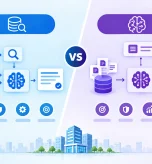


How AI-powered Progressive Web Applications Transform Enterprise UX, Speed, and ROI

In AI focused enterprise digital ecosystems, User Experience (UX) is no longer a surface-level concern. It directly influences adoption, efficiency, and long-term value. Speed, accessibility, personalization, and consistency across devices increasingly determine whether platforms are trusted, used, and relied upon at scale.
This shift has led many enterprises to re-evaluate how experiences are delivered. AI-powered Progressive Web Apps are emerging not simply as a modern delivery model, but as a practical way to align intelligent systems with real user workflows. When AI capabilities are paired with a performance-oriented PWA architecture, enterprises gain interfaces that adapt, respond, and scale without introducing unnecessary complexity.
Rather than treating UX as a design layer added at the end, organisations are beginning to approach it as an architectural outcome—one shaped by how intelligence, performance, and accessibility intersect, particularly in Progressive Web Apps for Enterprise AI initiatives.
Why UX Has Become Central to Enterprise Digital Success
Enterprise platforms today serve a wide range of users, including customers, partners, administrators, and internal teams. Despite differing roles, expectations have converged. Users expect fast access, relevant information, and seamless interaction regardless of device or context.
When enterprise UX fails to meet these expectations, the impact is measurable. Friction increases support overhead, slows task completion, and weakens confidence in the system. Over time, this erosion affects engagement, retention, and return on digital investment.
AI-powered Progressive Web Apps address these challenges by enabling experience consistency at scale. Instead of static interfaces that treat all users the same, enterprises can deliver adaptive experiences that reflect intent, context, and usage patterns without fragmenting platforms.
What Changes When AI Is Embedded into PWA UX
A conventional Progressive Web App already improves reach and performance by design. When AI-driven UX is introduced thoughtfully, the interface shifts from being reactive to being responsive to patterns and signals.
This does not mean adding intelligence everywhere. It means applying it where it reduces effort or improves clarity—such as anticipating likely actions, adjusting information density, or streamlining repetitive interactions through well-defined Predictive UX patterns. The result is a user experience that evolves based on real behaviour rather than predefined assumptions.
Enterprises benefit from delivering experiences that feel purposeful rather than overloaded, especially in systems where efficiency and accuracy matter more than novelty.
Personalisation That Supports Enterprise Outcomes
Personalisation in enterprise environments must be subtle and reliable. Overly aggressive adaptation can be distracting or counterproductive. AI-powered PWAs allow personalisation to occur within controlled boundaries, shaped by role, history, and task context.
Layouts, navigation cues, and content emphasis can adjust naturally as the system learns how different users interact with it. This reduces unnecessary steps and helps users focus on what matters most to them at any given moment.
From an organisational perspective, this leads to better engagement and smoother workflows without increasing maintenance overhead.
Performance as a UX Enabler, Not a Metric
Speed is one of the most immediate signals users perceive. Delays, even brief ones, disrupt flow and reduce trust. Progressive Web Apps are designed to mitigate these issues through service workers, intelligent caching, and offline-first patterns.
AI complements this foundation by enabling predictive loading, smarter resource use, and adaptive behaviour in constrained network conditions. Together, they create interfaces that remain responsive even as systems grow more complex.
Performance, in this context, is not just a technical benchmark—it is a prerequisite for usable and dependable enterprise UX.
Consistency Across Devices and Contexts
Enterprises often struggle with fragmented experiences across web and mobile platforms. Maintaining parity across native and web applications introduces duplication and drift over time.
AI-powered PWAs offer a unified experience layer that behaves consistently across devices while remaining responsive to context. This consistency reduces learning curves, improves accessibility, and strengthens trust in the platform as a whole.
For internal teams, it also simplifies onboarding and reduces reliance on extensive training.
UX-Driven ROI Through Reduced Friction
RoI from UX improvements is rarely immediate, but it is cumulative. AI-powered PWAs reduce friction across critical journeys—onboarding, data entry, approvals, and transactions—by preventing errors and simplifying decisions.
As systems learn from usage, they improve without constant redesign. This continuous refinement lowers support costs, increases completion rates, and improves overall efficiency without disrupting users.
The ROI emerges not from isolated features, but from sustained usability over time in AI-powered enterprise software environments.
Insightful UX Decisions Through AI Analytics
Traditional analytics describe what users do. AI-enhanced UX analytics help interpret patterns, identify friction points, and highlight opportunities for improvement.
By observing behaviour across sessions and contexts, enterprises can make UX decisions grounded in evidence rather than assumption. This allows teams to refine experiences incrementally while maintaining stability in production environments.
Scaling UX as Enterprises Grow
As platforms expand across regions, roles, and business units, UX quality often becomes harder to maintain. AI-powered Progressive Web Apps support scalability by adapting interfaces dynamically while preserving a shared design foundation.
This enables experimentation and localisation without compromising coherence, ensuring that growth does not dilute usability—an increasingly important consideration in large-scale PWA development.
Trust, Security, and UX Alignment
In enterprise contexts, trust is inseparable from experience. Security mechanisms that disrupt workflows undermine confidence, even when well intentioned.
AI-powered PWAs integrate security into the experience itself by detecting anomalies, adapting authentication, and maintaining continuity without forcing unnecessary friction. Users remain protected without feeling constrained.
A Strategic Shift Toward UX-Led Architecture
AI-powered Progressive Web Apps represent a broader shift in how enterprises approach digital systems. The focus moves from delivering features to enabling outcomes through experience design that is intelligent, resilient, and scalable.
When UX is treated as an architectural concern rather than a cosmetic one, platforms become easier to use, easier to evolve, and more valuable over time.
For enterprises navigating increasing complexity, UX-first AI-powered PWA development is no longer an experiment. It is a practical response to how modern systems are used—and how value is ultimately created.